
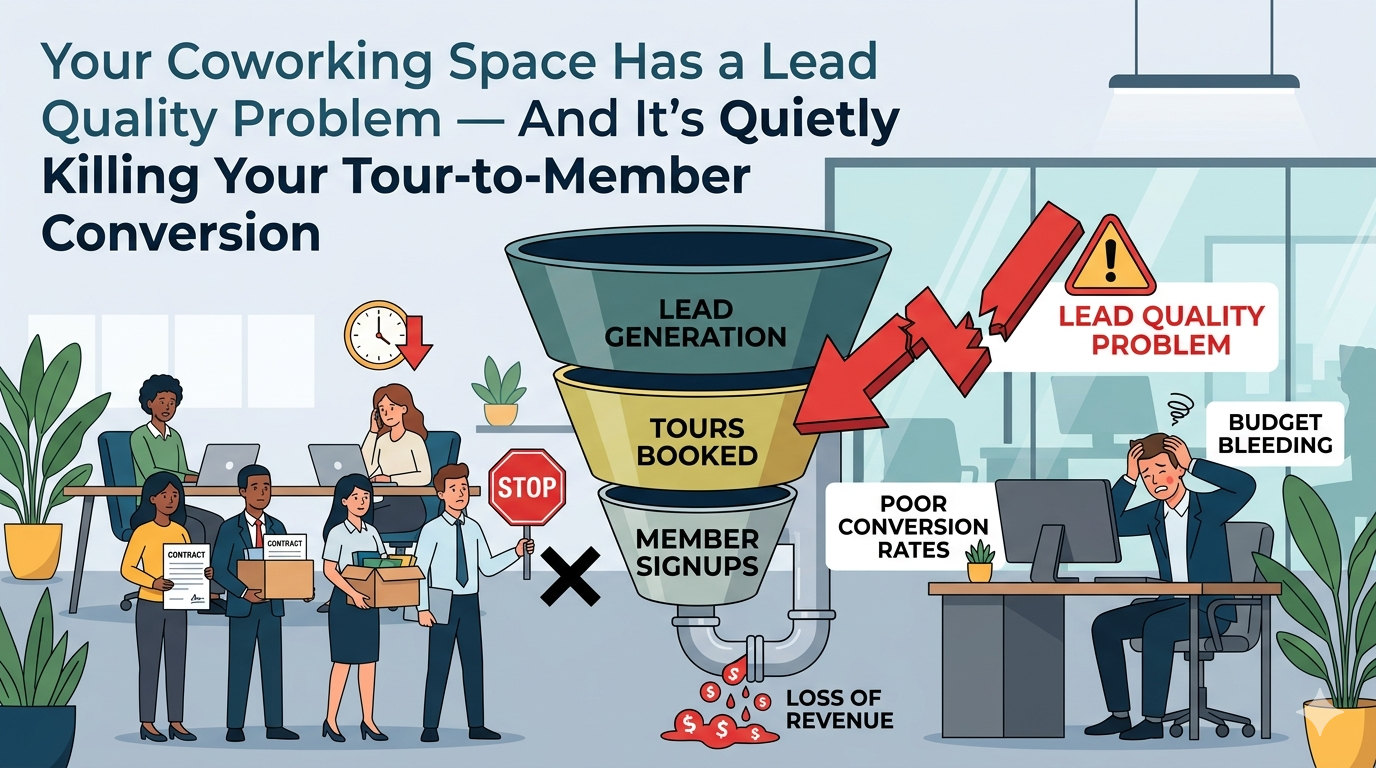
 Ask any coworking operator how business is going, and they’ll talk about occupancy, churn, and pricing. Ask them how many tour bookings they got last month, and they’ll quote a healthy number. Ask them how many of those bookings turned into a signed member, and the room goes quiet.
There is a gap between “enquiries” and “revenue” in almost every flexible workspace business, and most operators misdiagnose it. They assume it’s a sales-skill problem, or a pricing problem, or a location problem. Often, it is none of those. It is a lead quality problem — the pipeline is being polluted at the very top, before a salesperson ever picks up the phone. This piece is about where that pollution comes from, why it’s invisible on a dashboard, and how to stop it without spending a rupee on more marketing.
The metric that lies to you
Coworking operators live by the tour. The standard funnel looks clean: website visit → tour request → tour completed → trial → membership. So operators optimise for tour requests. More form fills, more demo bookings, more “Book a Visit” clicks. The marketing team is rewarded for volume.
The problem is that tour requests are the easiest number in the funnel to inflate and the hardest to keep honest. A workspace landing page with a prominent booking form is a magnet for exactly the kind of traffic that will never become a member:
- Competitors and brokers scoping your pricing and inventory anonymously
- Job-seekers and vendors using the form to get a contact, not a desk
- Bots and scrapers harvesting your contact and plan data
- Freebie-seekers chasing a day pass or a free-trial offer with no intent to pay
Every one of these submits a form. Every one of them inflates your “leads” number. And a large share of them do it using an email address you can never actually reach them on.
The disposable email blind spot
Here’s the mechanic almost no operator has examined. When someone fills your tour-booking or trial form but doesn’t want a follow-up — the competitor, the freebie hunter, the bot — they don’t type a fake-looking address that your form would reject. They use a real, working, fully deliverable address from a temporary email service: a disposable inbox that self-destructs after a few minutes. It passes every validation check you have. It accepts your confirmation email. Then it vanishes.
Now trace what that single submission does to your operation:
Your CRM count is wrong. That lead sits in the pipeline as “new enquiry.” Your weekly report shows healthy top-of-funnel. Leadership believes marketing is working. Nobody is alarmed because the number looks fine.
Your nurture sequence burns out. Your automated drip — “Thanks for your interest, here’s a brochure,” “Still thinking? Here’s a discount,” “Last chance for founder pricing” — fires into a mailbox that no longer exists. Every one of those sends bounces.
Your sender reputation degrades. Bounces from dead disposable addresses tell email providers your list is dirty. Over time, your real nurture emails to real prospects start landing in spam. The serious prospect who genuinely wanted to think it over never sees your follow-up — because the junk leads quietly poisoned your deliverability.
Your sales team wastes its most expensive hours. A community manager spends the morning calling numbers that don’t connect and emailing addresses that bounce, instead of working the three leads that would actually have converted.
The tour-to-member conversion rate looks terrible. The instinctive response — “we need a better closer” or “we need to discount harder” — treats a symptom. The disease is that a meaningful slice of the pipeline was never a prospect at all.
Why this hurts new and Tier-2 operators most
A mature workspace in a metro with a strong referral engine can absorb some pipeline noise. The operators who get hurt worst are exactly the ones with the least margin for error:
- Newly launched spaces running paid acquisition, where every junk lead is a real ad spend that produced nothing.
- Owner-operated and Tier-2 spaces with a one or two-person sales team, where an hour spent on a ghost lead is an hour stolen from a real one.
- Operators reporting to a landlord or investor, where an inflated lead number creates a false sense of safety right up until the month occupancy fails to move and trust collapses.
For these operators, lead quality isn’t a marketing nicety. It is the difference between a clean read on whether the business is working and a dashboard that lies until it’s too late to course-correct.
How to actually fix it (without more marketing budget)
The fix is not “generate more leads.” It is “stop counting the ones that were never real, and stop spending human time on them.” Three moves, in order of impact.
1. Filter junk at the point of capture, not after
The highest-leverage change is at the form itself. Before a submission is written to your CRM, screen the email address. Genuine prospects use durable, reachable addresses. A submission from a known throwaway domain can be flagged, deprioritised, or routed away from the sales queue automatically. Operators who block disposable addresses at signup typically see their “raw leads” number drop — and panic for about a day — until they realise their real conversion rate just jumped, because the denominator finally reflects reality. You didn’t lose leads. You stopped lying to yourself about how many you had.
2. Separate “enquiry volume” from “qualified enquiry” in every report
Stop reporting a single “leads” number to yourself, your landlord, or your investor. Report two: total form fills, and qualified enquiries (real, reachable, non-disposable, not a known competitor domain). The gap between those two numbers is one of the most useful diagnostics a workspace business has. If it’s wide, your acquisition channel is attracting the wrong traffic and no amount of sales coaching will fix it.
3. Protect the nurture channel deliberately
Your follow-up email sequence is an asset. Treat it like one. Suppress sends to bounced and disposable addresses so your sender reputation stays clean and your genuine prospects keep landing in the inbox. The single most underrated lever in coworking lead conversion is not a better pitch — it is making sure your second and third follow-up actually arrives in front of the people who were on the fence.
The launch-day version of this problem
If you are about to open a new space, you can build the defence in from the start instead of retrofitting it after the damage. When the new website goes live, two things should happen on the same day. First, the site needs to be discoverable — generating and submitting a complete sitemap so search engines index every plan and location page shortens the time to your first real enquiry. Second, the tour-booking form should screen email quality from its very first submission, so the pipeline starts clean and your earliest performance numbers actually mean something. Operators who bolt this on a year later spend that year making decisions on corrupted data.
What good looks like
A coworking operator with a healthy pipeline isn’t the one with the biggest “leads” number on the dashboard. It’s the one whose numbers are true:
- Tour requests reflect humans who can be reached and might pay.
- Conversion rate is measured against a real denominator, so it’s a usable signal.
- The sales team’s hours go to prospects, not to ghosts.
- Follow-up emails reliably reach the people still deciding.
- Reports to the landlord or investor describe reality, so trust survives the slow months.
None of that requires a bigger marketing budget. It requires refusing to let an inflated top-of-funnel number tell you a comforting story while occupancy quietly stalls.
The takeaway
In a flexible workspace, the loudest metric — tour bookings — is also the most easily corrupted. Disposable email submissions sit in your pipeline looking exactly like prospects, drain your team’s most valuable time, and degrade the deliverability of every genuine follow-up you send.
Fix lead quality before you touch anything else. Clean the data, count honestly, protect the nurture channel. A workspace business that knows its real numbers can be improved. One that doesn’t is just guessing — and in this market, guessing is how good buildings end up with bad occupancy.