
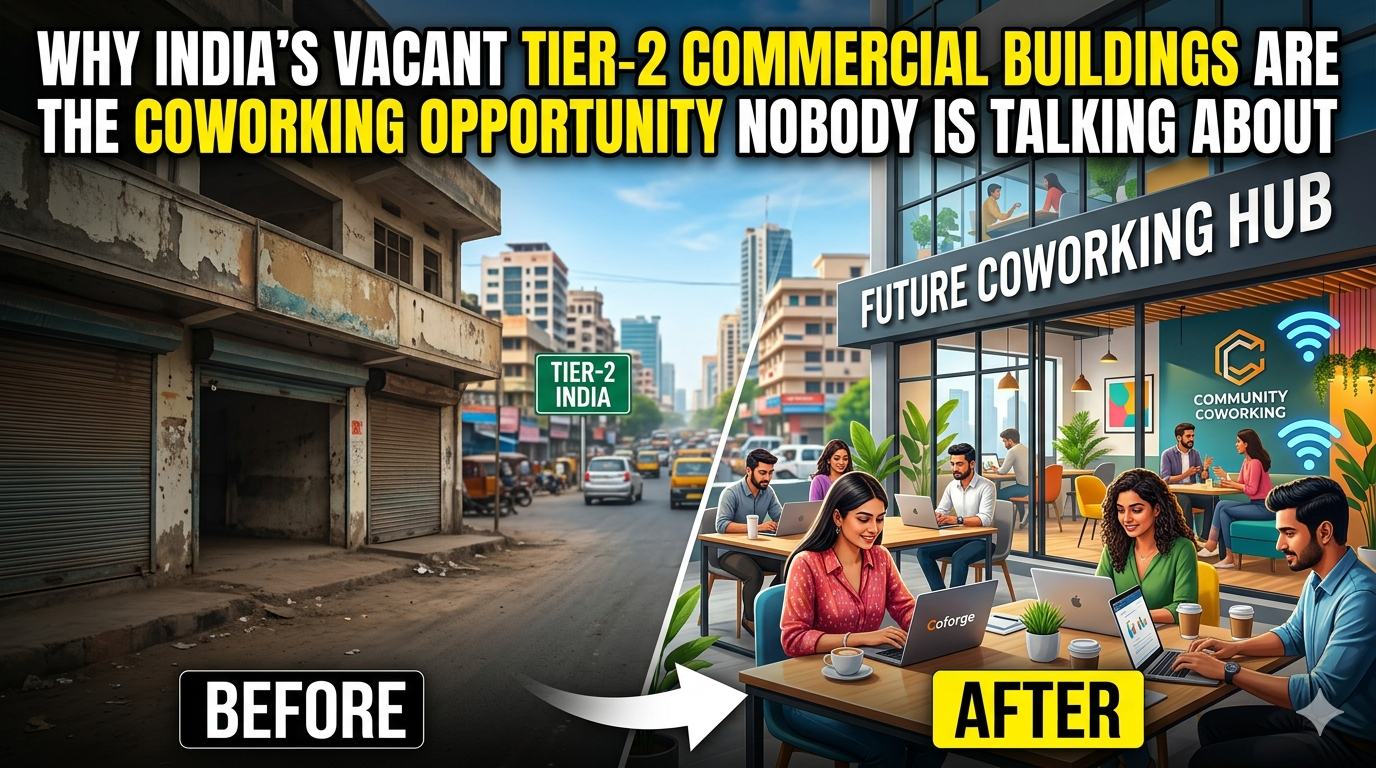
 Walk through the central business district of Indore, Coimbatore, Lucknow, or Surat today and you will see something the headlines don’t capture: floor after floor of commercial space sitting dark. Not under construction. Not newly delivered. Just empty — leased once, vacated quietly, and now carrying maintenance bills, property tax, and loan EMIs while producing nothing.
The national conversation about flexible workspace is almost entirely about Grade-A towers in Bengaluru, Gurugram, Mumbai, and Hyderabad. Every operator, every fund, every advisory firm is fighting over the same trophy assets in the same six micro-markets. Meanwhile, the largest pool of convertible, underpriced, demand-ready commercial real estate in the country is being ignored — because it doesn’t look glamorous on a pitch deck.
This is the overlooked opportunity. Let’s break down why it exists, who it belongs to, and how an owner actually captures it.
The structural shift behind the opportunity
Tenant behaviour in India’s office market has changed permanently, and not just in metros. Corporates have moved away from long, capital-heavy leases toward agile, on-demand occupancy. Startups want plug-and-play offices that scale up and down with headcount. Enterprises are running distributed teams and need satellite locations close to where talent actually lives — and a growing share of that talent now lives in Tier-2 cities, not in metro suburbs.
Three forces are compounding at once in these cities:
- Reverse migration of talent. Skilled professionals who moved to metros for jobs are increasingly choosing to work from their home cities. Companies are following them with smaller managed offices rather than forcing relocation.
- GCC and back-office expansion. Global capability centres and IT services firms are deliberately spreading delivery footprints into lower-cost cities to manage wage inflation and attrition.
- Local entrepreneurship density. D2C brands, agencies, fintech startups, and freelancers in Tier-2 cities have outgrown home offices and cafés but cannot justify a five-year lease and a ₹40-lakh fit-out.
Each of these groups wants the same thing: a professional, ready-to-use workspace with a short commitment. Almost none of the vacant buildings in these cities are configured to sell that. That mismatch — strong latent demand sitting next to dead supply — is the entire thesis.
Who actually owns this dead space (the segments nobody markets to)
The reason this opportunity stays open is that the owners of these assets are not the people advisory firms usually talk to. They fall into a few specific groups:
Dying retail and mixed-use building owners. Quick commerce and e-commerce have hollowed out mid-tier retail. Owners of half-empty shopping arcades and mixed-use blocks are sitting on large, regular floor plates with good frontage and parking — structurally excellent for flex workspace — while desperately Googling “alternate use for commercial building.” They almost never get a coworking pitch.
Absentee and NRI owners. A family owns two floors in their hometown’s business district. They live in another city, or another country. They don’t trust local brokers, the asset has been vacant for years, and “do nothing” feels safer than “do something.” For them, the deciding factor is not yield — it is whether someone else will run it end to end without their daily involvement.
Trust, institutional, and recovered assets. Educational trusts, hospitals, and old industrial families often hold idle adjacent buildings. Banks and asset reconstruction companies hold recovered commercial properties sitting as dead value on the books. All of them want recurring income; all of them are blocked by operational complexity, not by lack of demand.
These owners are not waiting for a better lease. They are waiting for someone to remove the operational risk. That is precisely where a structured conversion or operator-partnership model wins — and why the competition, fixated on metro towers, never shows up here.
The two paths an owner can take
Once an owner accepts that flex is the answer, there are two distinct routes, and choosing wrongly is expensive.
Path 1: Partner with an established operator
The owner contributes the asset; an experienced operator runs the workspace under a revenue-share, management-contract, or hybrid structure. This is the lower-effort, lower-variance route. It suits owners who want predictable income, no brand-building burden, and no exposure to day-to-day operations. The trade-off is a capped upside — the operator keeps a meaningful share of the value the asset creates.
Path 2: Build and operate your own brand
This is where the real long-term value uplift sits, and it is increasingly viable even for first-time owners because the launch cost of a brand has collapsed.
A decade ago, creating a credible workspace brand meant agencies, designers, and months of work. Today an owner can move from concept to a launch-ready identity in days. Naming is the first wall most owners hit — they sit on a shortlist of mediocre options for weeks. Running ideas through an AI-powered business name generator breaks that paralysis fast and produces a usable shortlist plus a logo direction without a five-figure design budget.
Naming is only half the job. A workspace brand has to be legally and digitally distinct in its city, or it bleeds search traffic and invites trademark trouble later. Before locking a name, a quick pass through a tool that checks how many similar businesses already exist tells you whether you’re walking into a crowded namespace — a fifteen-minute check that saves a rebrand two years in.
The owned-brand path demands more setup but it does something the partnership path cannot: it builds an income stream and a brand equity asset that lifts the capital value of the property itself. For owners who plan to hold, that compounding is the whole point.
Why “the market is structural, not experimental” matters for owners
The single biggest mistake Tier-2 building owners make is treating flex demand as a fad to wait out. They assume the long-lease tenant will eventually return if they hold out. The data says otherwise. Vacancy cycles for conventional space in these cities are lengthening, fit-out costs and tenant churn keep rising, and corporates have permanently repriced flexibility above commitment.
The owners who move early get three durable advantages: pricing power before the micro-market gets crowded, occupancy stability from a diversified tenant mix instead of single-tenant risk, and cash-flow resilience because shorter contracts and varied occupiers absorb shocks far better than one anchor lease. The owners who wait don’t get the old market back — they get a less relevant asset in a flexible-first economy.
The launch step is almost everyone underestimates
Say an owner takes the build-your-own-brand path, completes the fit-out, and opens. There is a quiet failure mode here that has nothing to do with real estate: the workspace is invisible online.
A coworking business lives or dies on local discovery. People searching “coworking space near me” or “managed office in [city]” must find you, and search engines must be able to crawl and index every page — locations, membership plans, the tour-booking form. Owners who treat the website as an afterthought launch a beautiful space that no one can find. Generating and submitting a proper XML sitemap for the new site the day it goes live is a ten-minute task that materially shortens the time between opening the doors and the first inbound enquiry.
And once those enquiries start, owners hit the next surprise — not every “lead” is real. Tour-booking forms on new workspace sites attract a heavy share of junk: bots, freebie-seekers, and signups using disposable addresses that can never be followed up or retargeted. Operators who filter out throwaway email addresses at the point of capture protect their sales team’s time from day one instead of discovering the rot three months in when the pipeline numbers stop making sense. (We’ll go deep on that lead-quality problem in a dedicated piece — it’s bigger than most operators realise.)
The takeaway for asset owners
The flexible workspace opportunity in India is not finished — it has barely started outside the top six cities. The vacant Tier-2 commercial building that feels like a liability today is, with the right conversion strategy and operating model, one of the highest-yield, lowest-glamour assets in the country.
The owners who win won’t be the ones with the best towers. They’ll be the ones who saw the dead floor space for what it actually is — a coworking business waiting for someone to run it — and moved before the rest of the market noticed.